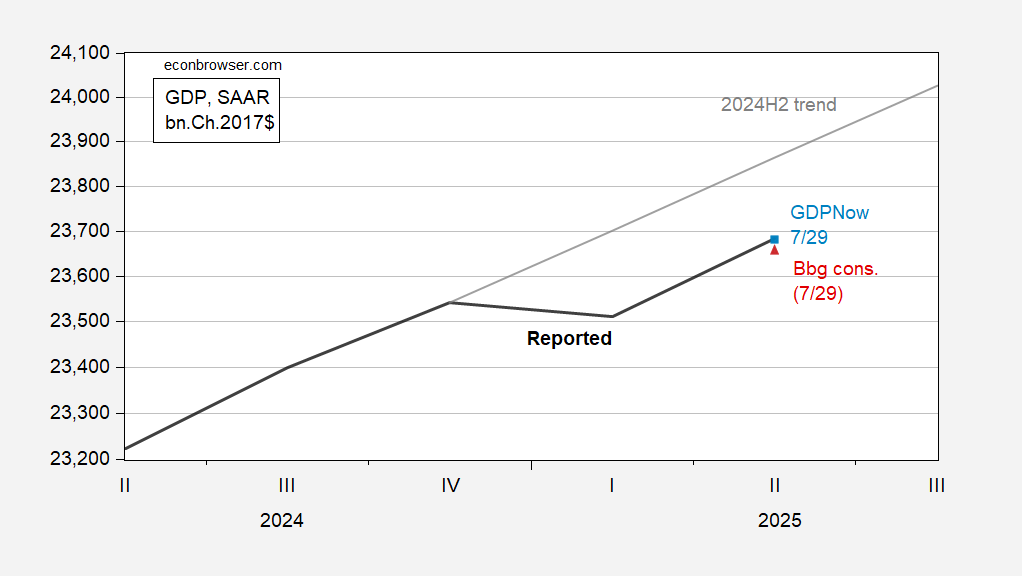
1781. State of the Macroeconomy: GDP, Key Indicators as of 7/31
Menzie Chinn analyzes GDP growth and key economic indicators, emphasizing the importance of private domestic purchases and discussing trends in economic activity as of July 2023.
your daily dose of economic commentary
Menzie Chinn analyzes GDP growth and key economic indicators, emphasizing the importance of private domestic purchases and discussing trends in economic activity as of July 2023.

The discussion highlights the disparity between high US health care spending and poor health outcomes, suggesting reforms to reduce costs and improve care efficiency.

An argument that interpreting traditional TWFE coefficients is more complex than understanding 2x2 difference-in-differences due to underlying calculations and assumptions.

Jon Murphy discusses the complexities of eminent domain, highlighting its potential benefits and pitfalls in different contexts of public works projects.

Rachel Treisman discusses a recall of High Noon hard seltzers due to mislabeling as Celsius energy drinks in several states.

Paul Krugman discusses the media's failure to accurately report on Trump's economic policies and the broader implications of misinformation in politics.

Bill McBride discusses the unchanged year-over-year shelter measure in the PCE report and its implications for inflation and housing trends.

Bill McBride discusses the increase in personal income and spending in June, along with related inflation data from the U.S. Bureau of Economic Analysis.

Omkar Khandekar discusses India's response to President Trump's threats regarding tariffs on Russian trade partners and its implications for the economy.
Brittney Melton discusses the Federal Reserve's decision to maintain interest rates and Texas Republicans' proposal for a new redistricting map.

Arezou Rezvani discusses NPR's interest in hearing from adults over 50 who struggle with retirement savings and financial security.

An argument that the Federal Reserve faces a significant financial loss due to pandemic-related quantitative easing measures.
Scott Cunningham argues against using two-way fixed effects models in differential timing diff-in-diff due to design flaws in causal inference.

Timothy Taylor discusses the insufficient progress in reducing US carbon emissions despite ambitious governmental goals and highlights the limited impact of these efforts globally.

An argument that revitalizing U.S. shipbuilding is essential for job creation and countering foreign competition, necessitating infrastructure and workforce development.

Recent GDP growth indicates a positive economic trend, though concerns remain about inventory management and potential inflation from tariffs.

Visitor traffic in Las Vegas declined significantly in June 2025, influenced by economic uncertainty and a decrease in convention attendance, with notable drops in hotel occupancy and revenue.

Camila Domonoske discusses how automakers are currently absorbing tariff costs rather than passing them on to consumers, but this may change in the future.

Scott Sumner critiques the use of the term "must" in economic discourse, arguing it obscures human choice and misrepresents market dynamics.

A personal account of designing a custom rug that combines traditional Afghan art with scientific motifs, emphasizing quality, affordability, and supporting local weavers.