
1281. Can a Despised Autocrat Consolidate Power?
An argument that explores whether a despised autocrat can consolidate power despite poor economic performance and widespread public disapproval, drawing historical comparisons.
your daily dose of economic commentary
An argument that explores whether a despised autocrat can consolidate power despite poor economic performance and widespread public disapproval, drawing historical comparisons.

Scott Horsley discusses a Labor Department report indicating that U.S. job growth may have been overestimated by 900,000 jobs in the past year.
Bill McBride discusses a preliminary benchmark revision indicating a downward adjustment of 911,000 jobs in the U.S. employment statistics for March 2025.

An argument that Western civilization is regressing by rejecting key technologies, drawing parallels to historical examples of societal decline due to anti-science sentiments.

Alex Mayyasi discusses the impact of corporate landlords on rent prices and neighborhood diversity, highlighting the challenges they pose to homeownership.
The post discusses Dean Karlan's experiences as USAID's chief economist, focusing on the challenges of implementing effective foreign aid and the impact of political constraints.

David Folkenflik discusses Rupert Murdoch's buyout of three children, impacting the control of his media empire.
Menzie Chinn discusses how Clifford Winston criticizes the Trump Administration's hiring of academics who compromise their standards, negatively impacting government performance.

A discussion on the decline of foreign tourism in the U.S., its economic implications, and the contradictions of protectionist policies regarding trade and foreign investment.

An argument that various economic indicators, including housing sales and the yield curve, are being monitored to assess potential recession risks in the U.S. economy.

An argument that cardboard box production serves as a leading economic indicator, reflecting consumer demand and potential recession signals through its fluctuations.

Paul Krugman criticizes Scott Bessent's attacks on the Federal Reserve and discusses the implications of Trump's administration's choices for economic leadership.

The post explores the evolving definitions of American identity, particularly among right-wing nationalists, emphasizing the complexities of ethnicity, ancestry, and cultural heritage in America.

Active single-family housing inventory decreased by 1.7% week-over-week, with notable trends compared to previous years and seasonal patterns observed since 2015.

Ticket sales for the upcoming World Cup are expected to be challenging and expensive for fans.

The discussion centers on food brands' decisions to eliminate artificial dyes while maintaining consumer appeal and the implications for marketing and perception.

The post discusses U.S. imports of oil products from India, highlighting the reliance on Russian oil by Indian refineries.
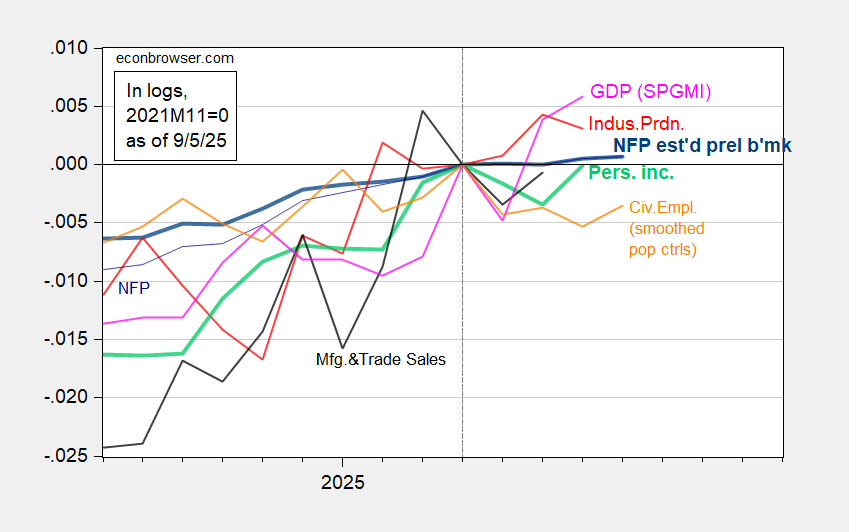
Menzie Chinn analyzes key economic indicators to assess whether the US is in a recession, focusing on employment and growth trends.

Sequoia Carrillo discusses Carlos Alcaraz's second U.S. Open victory, highlighting the match delay caused by the president's attendance.

A recall affects over 90,000 Jeep Grand Cherokees due to a risk of losing drive power, specifically targeting 2022 to 2026 plug-in hybrid electric models.