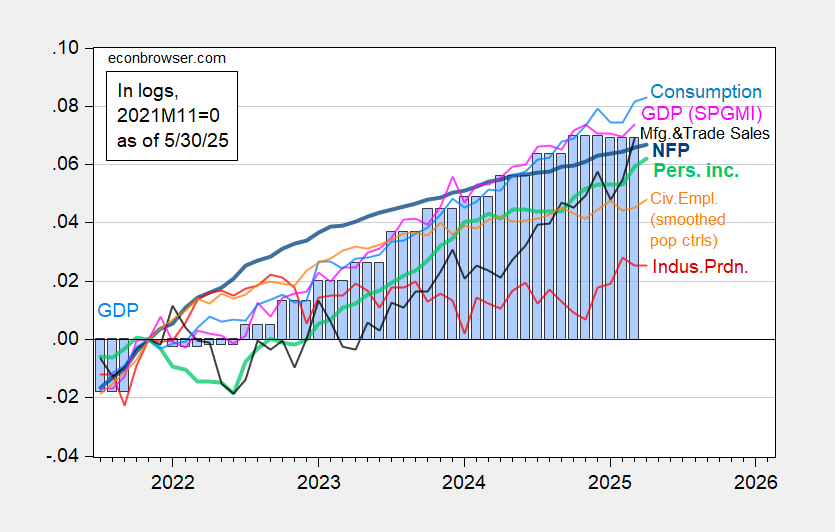
2561. Business Cycle Indicators as Reported at May’s End
Menzie Chinn discusses revisions in consumption and income levels, along with indicators of economic growth through April, based on various data sources.
your daily dose of economic commentary
Menzie Chinn discusses revisions in consumption and income levels, along with indicators of economic growth through April, based on various data sources.

The post discusses the recent decline in weekly COVID deaths, highlighting metrics and goals related to pandemic data reporting and wastewater analysis.

An argument that the U.S.-China trade war can be analyzed through game theory, exploring strategic decisions and potential outcomes of the involved leaders.

A lawsuit is filed against the Trump administration over an executive order threatening funding for public television networks.

Ryan Young discusses the fundamental role of trade in the evolution of life, illustrating how specialization and exchange led to complex organisms.
Timothy Taylor discusses the legal challenges to Trump's tariffs, focusing on the authority of the President and the implications for Congress's powers.

The post discusses GDP tracking estimates influenced by trade deficits, import-export fluctuations, and measurement challenges due to tariff impacts on economic growth.
Alex Tabarrok discusses how U.S. policies, particularly the Hatch-Waxman Act, have created a successful and competitive market for generic drugs, leading to lower prices.

Scott Cunningham reflects on the successful second edition of CodeChella, a workshop in Madrid focused on research methodologies and cultural experiences.
Paul Krugman discusses the influence of cryptocurrency on U.S. policy and its ties to corruption in politics, particularly regarding the proposed GENIUS Act.

Bill McBride discusses the year-over-year changes in shelter costs as measured by CPI and PCE, highlighting trends and implications for future rent increases.

Personal income and spending data for April 2025 show increases in both metrics, with inflation rates slightly below expectations, indicating economic growth trends.

Noah Smith discusses the changing narratives around wage stagnation and service costs in the U.S. economy, highlighting misconceptions from the past decade.
Brittney Melton discusses Trump's celebration of the U.S. Steel deal with Japan and speculates on the future of DOGE following Elon Musk's departure.
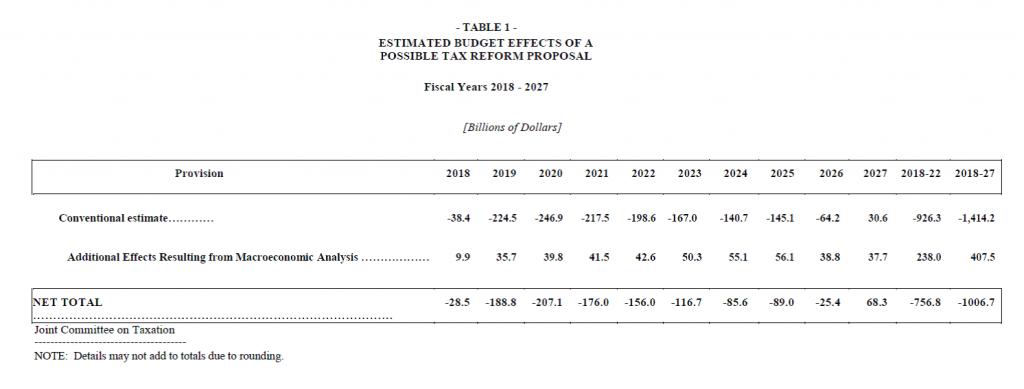
Menzie Chinn critiques Stephen Moore's allegations against the CBO's economic predictions and highlights the importance of accurate forecasting in policy-making.

A lawsuit alleges that oil companies' misrepresentations about climate change contributed to a woman's death during an extreme heat event.

Alina Selyukh discusses the potential impact of court rulings on Trump's tariffs and the uncertainty faced by American importers regarding refunds.

John Ruwitch discusses how AI-driven "vibe coding" allows anyone to create software without programming skills, raising concerns about job security for programmers.

Andrea Hsu discusses the impact of federal workforce reductions on American agriculture and pest control under President Trump's administration.
Timothy Taylor discusses the Supreme Court's ruling on NEPA and its implications for permitting reform in infrastructure projects, particularly regarding environmental impact assessments.